In July 2014, President Obama signed the Workforce Innovation and Opportunity Act (WIOA) the first update to the nation’s core workforce training programs in 16 years. The new law recognizes the need for new strategies and reauthorizes the nation’s employment, training, adult education, and vocational rehabilitation programs created under WIA in 1998. Read a summary of the key provisions of WIOA from CLASP and a side-by-side comparison of WIA and WIOA from the National Skills Coalition for more information.
|
As the U.S. federal government is embroiled in budget making chaos, its easy to fall back into the familiar "there is no money" refrain. Funding might be difficult to secure, but there are two groups of funders looking for communities working together to improve outcomes for "opportunity youth". Other organizations are helping individuals think creatively about revenue and funding sources. Check the following resources for more ideas...
National Youth Employment Coalition Opportunity Youth Incentive Fund National Clearinghouse on Families & Youth A Bridge to Reconnection: A Review of Federal Funding Youth Transition Funders Group Aspen Forum for Community Solutions has identified 21 communities who are working together for opportunity youth. These communities will receive funding and support to expand their efforts to reconnect youth and young adults. What are these communities doing? They:
1. Collaborate for impact 2. Build effective programs and pathways 3. Use data to guide decision and assess impact 4. Leverage funding to support and sustain innovation 5. Develop supportive policies. Read more about how community wide partnerships and initiative can come together for opportunity youth... 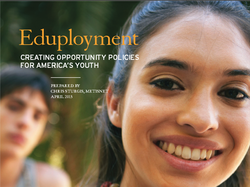 "Eduployment: The bifurcation of school and work, education and employment, college and career is out of date and meaningless. We need to use a both/and rather than an either/or framework in going forward. We call this eduployment."
This policy brief outlines the importance of and strategies to keep highly at-risk youth in school, connect them to meaningful work experiences, and help them succeed in postsecondary education. Read the Policy Brief... In a new KIDS COUNT policy report, the Casey Foundation finds that nearly 6.5 million U.S. teens and young adults are neither in school nor in the workforce. With employment among young people at its lowest levels since the 1950s, these youth are veering toward chronic unemployment as adults and failing to gain the skills employers need in the 21st century. In addition to new national and state data on the issue, the report offers recommendations to support youth in gaining a stronger foothold in the economy. Kids Count website... The Department of Labor details the WIA Youth program in a new publication. WIA Youth services are designed for youth who are low-income, in- or out-of-school, aged 14-21 with one or more of the following barriers to employment: (1) deficient in basic literacy skills; (2) a school dropout; (3) homeless, a runaway, or in foster care; (4) pregnant, or parenting; (5) an offender; or (6) an individual (including a youth with a disability) who requires additional assistance to complete an educational program or to secure and hold employment. These youth are eligible to receive services to prepare them for post-secondary educational and employment opportunities, attain educational and/or skills training credentials, and secure employment.
This program is designed to improve the long-term job prospects of young people by providing basic skills, work readiness skills, occupational training, and citizenship skills. Local communities collaborate and establish partnerships, bringing together local workforce training providers, schools, community-based organizations, and other entities. WIA calls on local areas to create opportunities for youth that integrate key programmatic components such as preparation for post-secondary opportunities, linkages between academic and occupational learning, connections to the local job market, and appropriate follow-up services. The White House Council for Community Solutions issues their final report on strategies to address the needs of opportunity youth. The recommendations address: cross-sector community collaborations, shared national responsibility and accountability, engaging youth as leaders in the solution and building on-ramps to employment.
The Council details the need for national and community level solutions. The most critical: * Integrated services and wraparound supports in workforce and education systems * Alternative education and employment pathways * Advanced credentialing opportunities Read the complete report.. A report commissioned by the White House Council for Community Solutions outlines the economic impact of the approximately 6.7 million 16-24 year olds considered "opportunity youth", those not in school and underemployed.
"These youth are disproportionately male and from minority groups, but substantial rates are found for all youth groups. Opportunity youth may have dropped out of high school or college and been unable to find work; may have been involved in the criminal justice system; may have mental or health conditions that have inhibited their activities; or may have care-giving responsibilities in their families. Some opportunity youth are ‘chronic’: they have never been in school or work after the age of 16. Others are ‘under-attached’: despite some schooling and some work experience beyond 16, these youth have not progressed through college or secured a stable attachment to the labor market. We estimate a chronic opportunity youth population of 3.4 million and an under-attached opportunity youth population of 3.3 million. Both groups are failing to build an economic foundation for adult independence." The report details the economic burden of opportunity youth including lost earnings, lost tax payments, crime, health costs, welfare support payments, and other losses in productivity and economic growth. In 2011 dollars, the report estimates that: Each opportunity youth imposes a social burden of $51,350 per year they are disconnected and after each opportunity youth reaches 25, he or she will subsequently impose a future lifetime burden of $699,770. These estimates support the compelling economic and social argument for workforce and educational supports for struggling young people. For more information on the cost calculations and the barriers that put these youth at risk, see The Economic Value of Opportunity Youth |